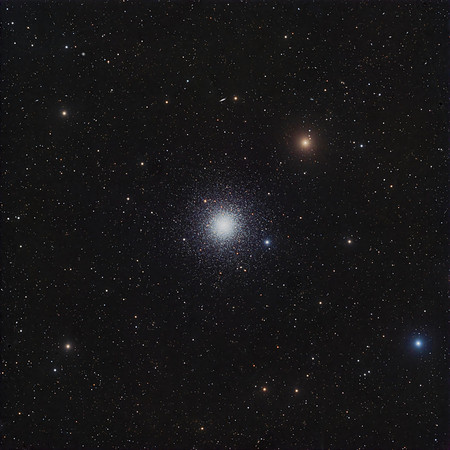
M3_RGB_SPCC_GradientRemoval_BlurX_NoiseX_Curves_HT_SatBoost
Discovered 1764 by Charles Messier.
M3 is one of the most outstanding globular clusters, containing an estimated half million stars. At a distance of about 33,900 light years, it is further away than the center of our Galaxy, the Milky Way, but still shines at magnitude 6.2, as its absolute magnitude is about -8.93, corresponding to a luminosity of about 300,000 times that of our sun. M3 is thus visible to the naked eye under very good conditions - and a superb object with the slightest optical aid. Its apparent diameter of 18.0 arc minutes corresponds to a linear extension of about 180 light years. It appears somewhat smaller in amateur instruments, perhaps about 10 minutes of arc. But its tidal radius, beyond which member stars would be torn away by the tidal gravitational force of the Milky Way Galaxy, is even larger: About 38.19 minutes of arc. Thus, this cluster gravitationally dominates a shperical volume 760 light years in diameter.
--------------------------------------
Camera: Moravian G4 (16803) with Astrodon RGB Gen II filters
Scope: AP155EDF w 4" FF and Focus Boss II motorized focuser
Mount: Paramount MX
RGB 12/11/11 x 10 min for each channel
Image calibration and RGB master in PixInsight: SPCC, BlurX, NoiseX, Curves, HT, Saturation Boost, DBE
Finishing touches in Photoshop CC
Lucknow, Ontario
April 2025