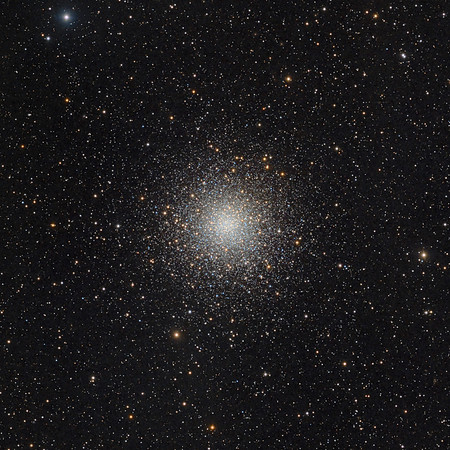
M10_RGB_SPCC_BlurX_NoiseX_Gradient_Curves_HT_ACDNR_SatBoost_TightCrop_Flat
M10 - Globular Cluster in Ophiuchus
Mag 6.6, 20 arcminutes across
RA 16 58' Dec -04 07'
-------------------------------
This from SEDS.ORG:
Discovered 1764 by Charles Messier. Messier 10 (M10, NGC 6254) is one of the bright globulars populating constellation Ophiuchus. This 7th mag globular cluster appears at about 8 or 9 arc minutes diameter when observed visually in smaller instruments. Average photos show it at about 15.1 arc minutes diameter, and deep photos show it to reach out to about 20 arc minutes, or 2/3 of the diameter of the Full Moon. At its distance of 14,300 light years, this corresponds to a linear diameter of 83 light years. Its brighter core which can be seen visually is only less than half as large, about 35 light-years. It is receding from us at 69 km/sec. According to Burnham, the extremely low number of only 3 variables has been found in M10; the ``Catalog of Galactic Globular Clusters" of R. Monella of the Sharru Astronomical Observatory, COVO (Bergamo), Italy (ADC/CDS number VII, 103) gives the number of 4. This globular cluster was discovered by Charles Messier on May 29, 1764, cataloged as No. 10 in his list, and like most globular clusters, described as "Nebula without stars" of round shape. William Herschel was the first to resolve it into stars.