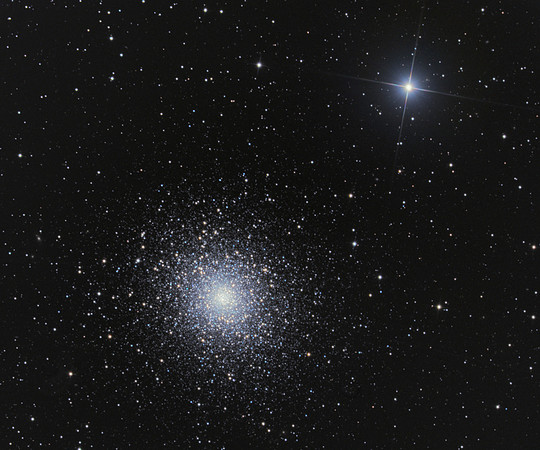
M5_LRGB_PW_U16M_Big
Discovered 1702 by Gottfried Kirch.
Globular cluster M5 was first seen by Gottfried Kirch and his wife Maria Margarethe on May 5, 1702, when they observed a comet, and described as a "nebulous star". Charles Messier found it independently on May 23, 1764, and described it as a round nebula which "doesn't contain any stars". William Herschel was the first to resolve this cluster into stars; he counted 200 of them with his 40-foot [FL] reflector in 1791, "although the middle is so compressed that it is impossible to distinguish the components."
M5 shows a distinct ellipticity; it is thought to be one of the oldest globular clusters, with a computed age of 13 billion years. Its diameter is about 165 light years, making it one of the larger globular clusters. At its distance of 24,500 light years, this diameter is about 23 minutes of arc. Visually it appears somewhat smaller, about 10 or 12 arc minutes. The cluster gravitationally dominates a spherical volume of over 400 light years diameter. It has a compressed central core of 0.84' angular, or roughly 6 light years diameter, and its half-mass radius is estimated at 2.11', corresponding to a linear radius of 15 light years.
M5 is receding from us at about 52 km/sec. M5 contains the considerably large number of 105 known variable stars.
======================
Click on the image above to see it twice as large.
Imaging Details:
Scope: Planewave 12.5" CDK
Camera: Apogee U16M w Astrodon Gen II LRGB filters
Mount: Paramount ME (MKS5000)
Guiding: SBIG ST-402ME and Astrodon MMOAG
LRGB: 5/6/6/6 x 10min
Image acquisition via TSX and CCD-Commander
Calibration and initial combines in Maxim
Colour combine, Levels and Curves, Photoshop CS4
Lucknow, Ontario, Canada
April 26, 2015