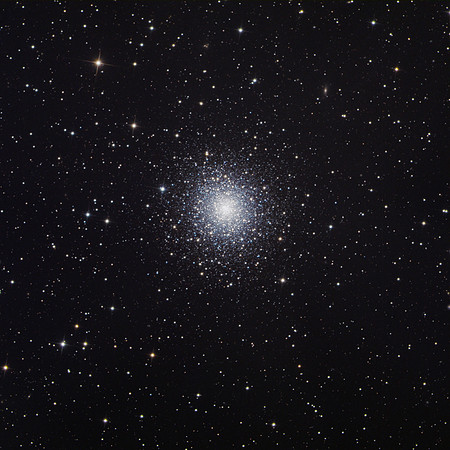
M92_LRGB_PW_U16M_BIG
M92 - The 2nd Great Globular Cluster in Hercules ------------------------------- This from SEDS.ORG:
Discovered 1777 by Johann Elert Bode.
Globular cluster Messier 92 (M92, NGC 6341) is one of the more conspicuous globular clusters. Situated in constellation Hercules, it is nevertheless second only within that constellation, after bright M13.
M92 is one of the original discoveries of Johann Elert Bode, who found it on December 27, 1777. Charles Messier independently rediscovered it and cataloged it on March 18, 1781, the same day as he cataloged another 8 objects, all of them Virgo Cluster galaxies (M84-M91). It was William Herschel who first resolved it into stars in 1783.
M92 is about 26,000 light years distant, only little more than its brighter apparent neighbor M13. A recent estimate of M92's age has given a value of more than 14 billion years. However, this value is now again under discussion because of the general modifications of the distance scale of the universe, implied by results of ESA's astrometrical satellite Hipparcos: These results suggest that M92, as well as most other globular clusters, may be at a 10 per cent larger distance; therefore, the intrinsical brightness of all their stars must be about 20 % higher. Considering the various relations which are important for understanding stellar structure and evolution, they should also be roughly 15 % younger, in a preliminary off-hand estimate (or about 12-14 billion years).
M92 is a splendid object, visible to the naked eye under very good conditions and a showpiece for every optics. It is only slightly less bright but about 1/3 less extended than M13: its 14.0' angular extension corresponds to a true diameter of 109 light years, and may have a mass of up to 330,000 suns.M92 is approaching us at 112 km/sec. ------------------------------- Camera: Apogee U16M w Astrodon Gen II LRGB Filters Telescope: Planewave 12.5 CDK at F/8 Mount: Paramount ME Guiding: Astrodon MMOAG w SBIG ST-402ME guide camera Luminance 14 x 10 min RG 9 x 10 min, B 5 x 10 min Acquired using CCD-Commander, CCDSoft5 and TheSky6 Pro All images aligned and combined in Maxim Imported into PS CC with FITS Liberator Levels and Curves in PS CC, some sharpening followed by Reduce Noise on background
Flesherton, Ontario June 2014