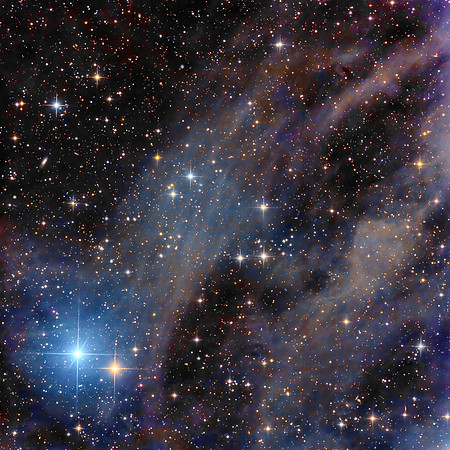
Sh2_73_LRGB_via_PI_Crop_Clarity_cleanup_via_PS
From Wikipedia:
"Sh2-73 is a reflection nebula visible in the constellation of Hercules. Originally mistaken for an H II region, it was later discovered to be illuminated by the Milky Way as a whole, and is therefore part of what is called an "IFN" (Integrated Flux Nebulae) .
It can be observed in the southwestern part of the constellation, bordering the Serpent Head and Corona Borealis . It appears as a very faint filament, barely perceptible in sensitive astronomical photographs and completely invisible to casual amateur observation. The most suitable period for observing it in the evening sky is from March to September, and it is visible from both hemispheres, despite being located north of the celestial equator. Sh2-73 is one of the closest clouds to the Solar System, at only about 200pc (∼652 ly )."
---------------------------------------
Imaging Details:
Telescope: Planewave 12.5" CDK w Astrodon MMOAG and ST402ME autoguider
Camera: Apogee U16M (16803 chip) w 7-position filter wheel and Astrodon Gen II Filters
Mount: Paramount ME from Software Bisque
LRGB: 27/8/11/10 x 10 min per channel
Acquisition in TSX via CCD-Commander
Bulk of processing PixInsight and some clean-up in Photoshop
Lucknow, Ontario, Canada
April 2026