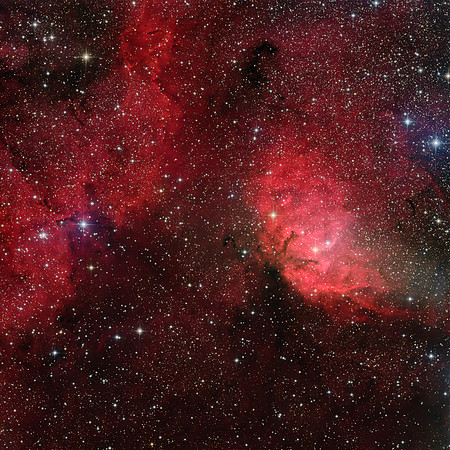
Sh2_101_PW_U16M_HaRGB_via_HaRGB_Combine
The Tulip Nebula in Cygnus - the above image is an H-Alpha / RGB combination using the HaRGB_Combine process in PixInsight. Some additional tweaks in PS
Sharpless 101 (Sh2-101) is a H II region emission nebula located in the constellation Cygnus. It is sometimes also called the Tulip Nebula because it appears to resemble the outline of a tulip when imaged photographically. It was catalogued by astronomer Stewart Sharpless in his 1959 catalog of nebulae. It lies at a distance of about 6,000 light-years from Earth. Sh2-101, at least in the field seen from Earth, is in close proximity to microquasar Cygnus X-1, site of one of the first suspected black holes. [Wikipedia]
Scope: 12.5" Planewave CDK
Camera: Apogee U16M w Gen II Astrodons
Mount: Paramount ME guided w an SBIG ST-402ME via Astrodon MMOAG off axis guider
22 x 20 min of H-Alpha
11/11/14 x 10 min each of RGB
Acquired with CCD-Commander and TheSkyX
Calibration and colour combine in PixInsight
RGB: GradientCorrection, SPCC, BlurX then StarX
Starless RGB: MAS, NoiseX, Curves, HT, LHE
StarsONLY RGB: HT, Curves, Masked Saturation Boost then Stars Back In via PixelMath. Save-as-TIFF
H-Alpha: BlurX, NoiseX, StarX, MAS, HT, LHE, Save-as-TIFF
Photoshop Processing: Added the Ha as a Lighten layer and toggled off G and B impact. Camera Raw filter (clarity and texture). Blurred the star cores since they got kinda blown out.