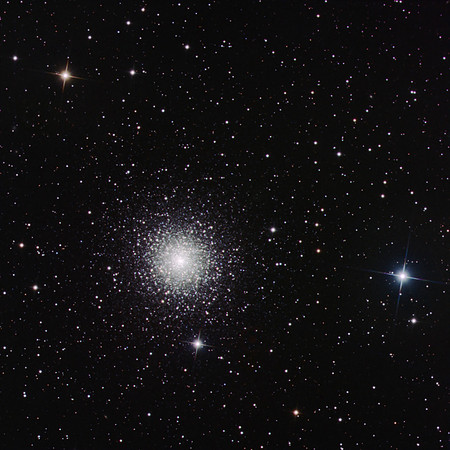
M15_RGB_Big
This from SEDS.ORG: Discovered by Jean-Dominique Maraldi in 1746. Globular cluster Messier 15 (M15, NGC 7078) is among the more conspicuous of these great stellar swarms. At a distance of about 33,600 light years, its diameter of 18.0 arc min corresponds to a linear extension of about 175 light-years. Its brightest stars are of a luminosity of 1,000 times that of our Sun. The globular cluster is approaching us at 107 km/sec.
M15 is perhaps the densest of all (globular) star clusters in our Milky Way galaxy. M15's core has undergone a process of contraction called "core collapse", which is common in the dynamical evolution of globulars; of the 150 known globular clusters within our Milky Way Galaxy, 21 have been found to contain a collapsed core. This central core is extremely small compared to the cluster, only about 1.4 light years. The half-mass radius is about 10 light years - half the mass of this cluster is concentrated in the innermost sphere of that radius. It is still unclear if the central core of M15 is packed so dense simply because of the mutual gravitational interaction of the stars it is made of, or if it houses a dense, supermassive object, which would be resembling the supermassive objects in galactic nuclei. The one in M15 would be among the nearest and better observable to us, being only little more remote than the Galactic Center and much less obscured by interstellar matter. Although the true nature of these objects remains obscure for the moment, many scientists believe they are strong candidates for "Black Holes".
M15 was discovered by Jean-Dominique Maraldi (Maraldi II, 1709-88) on September 7, 1746 while he was looking for De Chéseaux' comet; he described it as 'A nebulous star, fairly bright and composed of many stars'.Charles Messier, who cataloged it on June 3, 1764, and Johann Elert Bode couldn't make this out and described it as 'nebula without stars,' so that it remained to William Herschel in 1783 to resolve this fine star cluster.
M15 contains the considerable number of 9 known pulsars, neutron stars which are the remnants of ancient supernova explosions from the time when the cluster was young. Binary pulsar PSR 1534+12, is of particular interest because they exhibit strong general-relatistic gravitational effects (and is thus a natural laboratory to test Einstein's General Relativity Theory) such as significant perihelion shifts, effects on light, and emission of gravitaional radiation. The latter effect, the emission of gravitational radiation, carries away rotational energy and causes a slowdown of the pulsar frequency as well as of the orbital period.
------------------------------- Camera: Apogee U16M w Astrodon Gen II LRGB Scope: 12.5" Planewave CDK Mount: Paramount ME guided with an SBIG ST-402ME and Astrodon MMOAG RGB 6 x 10 min Acquired with CCDSoft5 and CCD-Commander All images reduced aligned and combined in Maxim Colour combines, Levels and Curves in PS CS6 Flesherton, Ontario Sept 2013