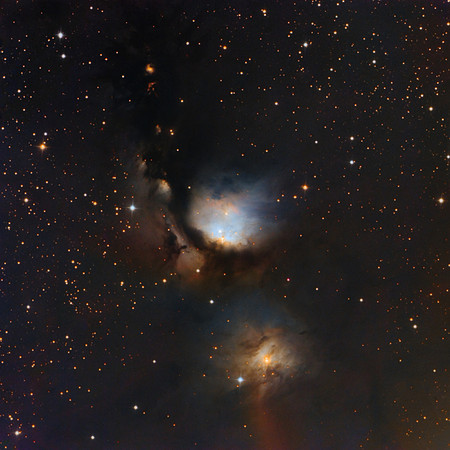
M78_LRGB_U16M_PW_Mar2018
Discovered 1780 by Pierre Méchain.
M78 is the brightest diffuse reflection nebula in the sky. Discovered by Pierre Méchain in early 1780, Charles Messier added it to his catalog on December 17, 1780. It belongs to the Orion complex, a large cloud of gas and dust centered on the Orion Nebula M42/M43, and is about 1,600 light years distant. It is the brightest portion of a vast dust cloud. Together with some other nebulae, including NGC 2024 (Orion B) near Zeta Orionis (sometimes called the Flame Nebula), all these nebulae are associated with the molecular cloud LDN 1630 (from Lynds' Catalogue of Dark Nebula), a part of the Orion complex.
At its distance, M78 measures almost 4 light years in extension.
M78 is not difficult to locate from Zeta Orionis, also named Alnitak, the easternmost star of Orion's Belt; M78 is situated about 2 degrees north and 1 1/2 degrees east of this star; a chain of 3 stars of mag 5..6, northward from Zeta, may help locating it. Alternatively, it is found roughly 1/2 deg North and 3 3/4 deg East of Delta Orionis, the NW most belt star.
Visually, M78 resembles a faint comet. It is just visible in binoculars under good conditions, as a very dim patch. Small telescopes already show it remarkably bright, and reveal the two illuminating stars, lying North preceding (NW) and South following (SE) like a double nucleus in the compact "comet head" part of M78; suggestions of a short and broad "tail" appear to reach to the South preceding (SW) end. Stars are fewer to the west, an indication that in this region dark nebulae seem to obscure the stellar background.